Scientists Identify Key Gene for Perennial Growth Habit in Wild Rice
On March 20, 2026, Science published online a research paper titled "Resetting of a tandem microRNA156 enables vegetative perennial growth in rice," jointly completed by the research groups led by Bin HAN and Jia-Wei WANG from the Center for Excellence in Molecular Plant Sciences (CEMPS), Chinese Academy of Sciences (CAS).
The research teams have cloned EBT1, a key gene that determines the perennial growth habit of wild rice, and revealed that changes in the expression pattern of this gene underlies the transition of rice from perennial to annual during domestication.
The teams first conducted a systematic phenotypic survey of 446 wild rice accessions. They found that, unlike annual cultivated rice, some wild rice plants did not senesce and die after seed maturation. Instead, new branches continuously emerged from axillary buds at the nodes. These branches elongated and spread outward, and once they contacted the soil they produced roots and developed into new plants, forming a weedy growth habit. This phenotype results from a reversal of developmental programming after flowering—plants return from reproductive growth to vegetative growth, a phenomenon known as “floral reversion.” Through this mechanism, the plants acquire a perennial lifestyle with clonal propagation.
To identify the genetic basis of this perennial trait, the teams crossed the perennial Dongxiang wild rice (Oryza rufipogon) accession W1943 with the annual indica cultivar Guangluai 4 (GLA4) and developed chromosome segment substitution lines for forward genetic analysis. Using fine map-based cloning, the teams ultimately identified the responsible gene, which they named Endless Branches and Tillers 1 (EBT1). The locus consists of two tandemly arranged microRNA genes, MIR156B and MIR156C.
It has been well established that miR156 functions as a developmental “age switch” in plants, regulating the progression of plant development. According to the classical model, miR156 is highly expressed during the juvenile stage and gradually declines as plants age, promoting the transition from vegetative to reproductive growth. Surprisingly, the teams discovered that although MIR156B/C in wild rice follow a similar developmental expression pattern, they are reactivated in the axillary buds of tiller nodes after flowering. This resetting of expression enables axillary buds to undergo developmental reversion, regain vegetative growth capacity, and continuously produce new tillers, thereby generating a clonal growth pattern. Further analyses revealed that this unique expression pattern is closely associated with the epigenetic state of the EBT1 locus in wild rice.
Population genomic analyses comparing wild and cultivated rice showed that the genomic region harboring EBT1 experienced artificial selection during rice domestication. This finding suggests that while selecting for higher yield and more compact plant architecture, early farmers may have inadvertently eliminated the perennial trait present in wild rice.
To further verify the above results, the teams combined EBT1 with two previously identified rice prostrate growth genes, PROG1 and TIG1. This gene combination successfully generated wild-rice-like plants that reproduce the weedy growth habit of wild rice. These plants exhibit strong clonal propagation ability and can survive for at least two years under field conditions in Hainan, China.
Together, this study provides novel insights into the evolutionary transition of plant life-history strategies and offers important genetic resources and theoretical foundations for the development of perennial rice varieties and the improvement of ratoon rice breeding.
The study was led by Prof. Bin HAN and Prof. Jia-Wei WANG from CEMPS (CAS), who served as co-corresponding authors. Dr. Bingxin DAI, Danfeng LV, and Dr. Erwang CHEN are the co-first authors of the study. The research was supported by the National Natural Science Foundation of China, the Ministry of Agriculture and Rural Affairs Key Program, the Strategic Priority Research Program of the Chinese Academy of Sciences, New Cornerstone Science Foundation, and Science and Technology Commission of Shanghai Municipality.
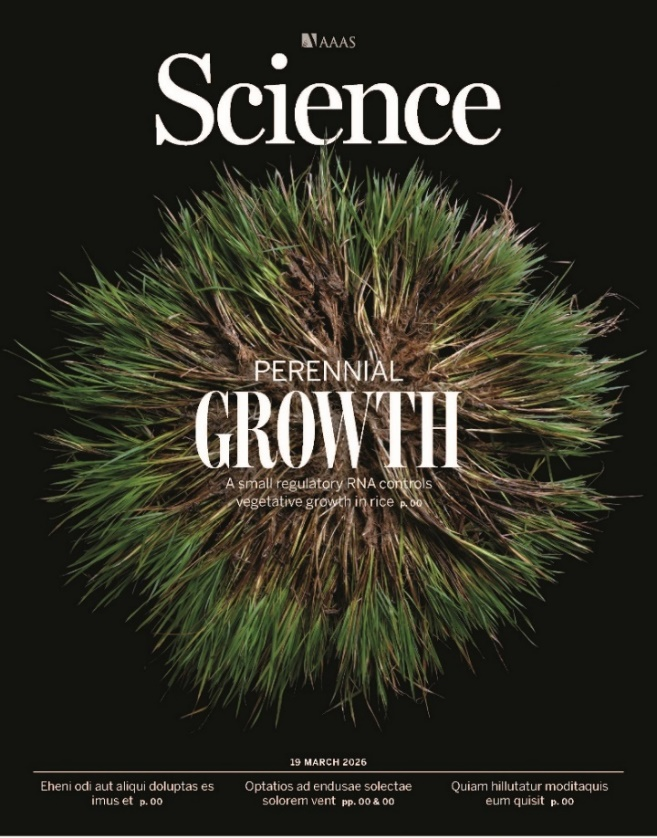
Article cover image
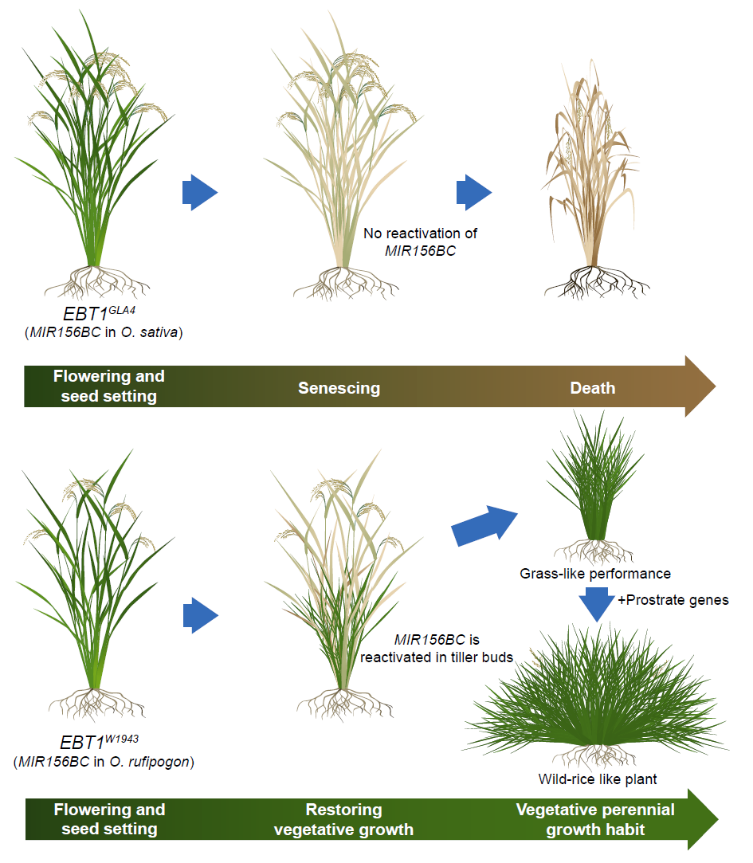
Reactivation of MIR156BC mediates the shift from annual to vegetative perennial growth in rice
Top: Cultivated rice follows a determinate life cycle from flowering and seed set to senescence, without reactivation of MIR156BC. Bottom: In cultivated rice carrying the wild rice MIR156BC allele, MIR156BC is reactivated in tiller buds after flowering, enabling continued growth and a grass-like performance characterized by floral reversion, and vegetative propagation. Additional introgression of prostrate growth genes further transforms the plant into a wild-like form, supporting vegetative perennial growth.
Article Link:https://doi.org/10.1126/science.adv2188
Contact:bhan@ncgr.ac.cn

Copyright @copy 2002-
CAS Center for Excellence in Molecular Plant Sciences / Institute of Plant Physiology and Ecology
All rights reserved
Address: 300 Feng Lin Road, Shanghai 200032, China
Tel: 86-21-54924000
Fax: 86-21-54924015
Email: webmaster@sippe.ac.cn