Immune Domestication and Broad-spectrum Disease Resistance Breeding in Rice
Over the past 15 years, frequent typhoons driven by global warming, together with the narrow germplasm of modern rice and accelerated pathogen evolution, have led to the continuous spread and severity of bacterial blight (BB) caused by Xanthomonas oryzae pv. oryzae (Xoo). The prevalence of this disease now poses a major threat on rice production. Therefore, discovery and breeding application of BB resistance genes are of strategic importance for ensuring stable rice production in Asia.
Crop disease resistance has been shaped by domestication, which fundamentally requires growth-defense balance under different agricultural conditions. Whether the plant immunity machinery has undergone differential artificial selection during crop domestication, however, remains unclear. Most cloned BB resistance genes (Xa) to date either originate from wild rice relatives or are loss-of-function mutations in susceptibility genes, suggesting that BB resistance may have been negatively selected during rice domestication. Given the long-standing puzzle of field resistance differences between the rice subspecies, indica and japonica, elucidating how R genes and their regulatory networks were differentially selected during domestication-particularly during subspecies formation-is essential for guiding disease resistance breeding in rice.
On 09 April 2026, the research team led by Professor Zuhua He from the Center for Excellence in Molecular Plant Sciences, Chinese Academy of Sciences, together with Professor Gongyou Chen’s team (Shanghai Jiao Tong University) and Professor Yiwen Deng’s team (Zhejiang University), published a paper titled “Asymmetric selection of a rice immune module and rebuild of disease resistance” in Nature. The study reports the cloning of the broad-spectrum BB resistance gene Xa48. It provides the first elucidation of a new model for broad-spectrum, durable BB resistance involving an NLR immune receptor and its cognate effector, and reveals the molecular mechanism by which XA48 coordinates growth and immunity during crop domestication. Furthermore, the study offers the first paradigm that integrating the two layers of plant immunity, PTI and ETI, can provide broad-spectrum disease resistance in modern crops.
Through large-scale germplasm mining, the team identified a novel BB resistance gene, Xa48, in the indica rice variety “Shuangkezao” (SKZ). Using map-based cloning combined with GWAS analysis, they cloned the gene and showed that it encodes an NLR receptor protein. Further screening and functional characterization identified its pathogenic cognate effector, XopG, and demonstrated that XA48 directly recognizes XopG to trigger immune responses. Systematic genetic, biochemical, and cell biology studies revealed that upon XopG recognition, XA48 promotes degradation of the downstream immune suppressor OsVOZ1/2, thereby derepressing OsJAZs and ultimately activating immune responses. This discovery provides a key foundation for breeding high-yielding, disease-resistant rice varieties.
To understand how XA48 balances growth and immunity, the team investigated its domestication trajectory. They discovered that the downstream transcription factor OsVOZ1 has evolved two allelic variants: OsVOZ1A and OsVOZ1S. Japonica rice carries only OsVOZ1A, while indica rice retains both. The combination of Xa48 and OsVOZ1A imposes a reproductive penalty in japonica-an effect not seen in indica, leading to the functional loss of Xa48 in japonica. Accordingly, Xa48 is present only in indica (regardless of the OsVOZ1 variant), which has been historically grown in Southeast Asia, a region with high BB incidence. This geographic distribution is consistent with negative selection acting on the resistance gene in japonica, which is traditionally grown in Northeast Asia with less BB occurrence.
Through long-term studies, they established an immune research platform centered on Rax21-XA21 (PTI) and AvrXa48-XA48 (ETI) to systematically investigate their synergistic effects during pathogen infection. Accordingly, the team developed a comprehensive PTI+ETI platform for improving BB resistance, which integrates PTI and ETI immune networks, and reconstitutes wild rice broad-spectrum resistance in modern rice, offering a novel strategy for green control of crop diseases. Thus, they provide the first practical model for broad-spectrum resistance breeding in crops.
This research thus has created an innovation in both the mechanistic understanding of biological processes and application in crop breeding, laying a critical foundation for advancing plant protection and achieving breakthroughs in crop breeding in China. Importantly, the Xa21 plus Xa48 genes , and providing crucial genetic resources and technical support for improving crop disease resistance in China have been widely adopted in rice breeding programs, demonstrating successful translation from fundamental science to practical application.
The co-corresponding authors are HE Zuhua (Center for Excellence in Molecular Plant Sciences, Chinese Academy of Sciences), CHEN Gongyou (Shanghai Jiao Tong University), and DENG Yiwen (Zhejiang University). The co-first authors are LIN Hui(Center for Excellence in Molecular Plant Sciences, Chinese Academy of Sciences), CHEN Fudan (Zhejiang University), CHENG Guanyun(Shanghai Jiao Tong University), YAN Bingxiao(Center for Excellence in Molecular Plant Sciences, Chinese Academy of Sciences), YUAN Meng(Huazhong Agricultural University), and QIU Jie(Shanghai Normal University). This work was supported by the Biological Breeding-National Science and Technology Major Projects, the National Natural Science Foundation of China, the Chinese Academy of Sciences, the National Key Research and Development Program of China, Shanghai Science and Technology Development Funds, and Shanghai Agricultural Science and Technology Innovation Program.
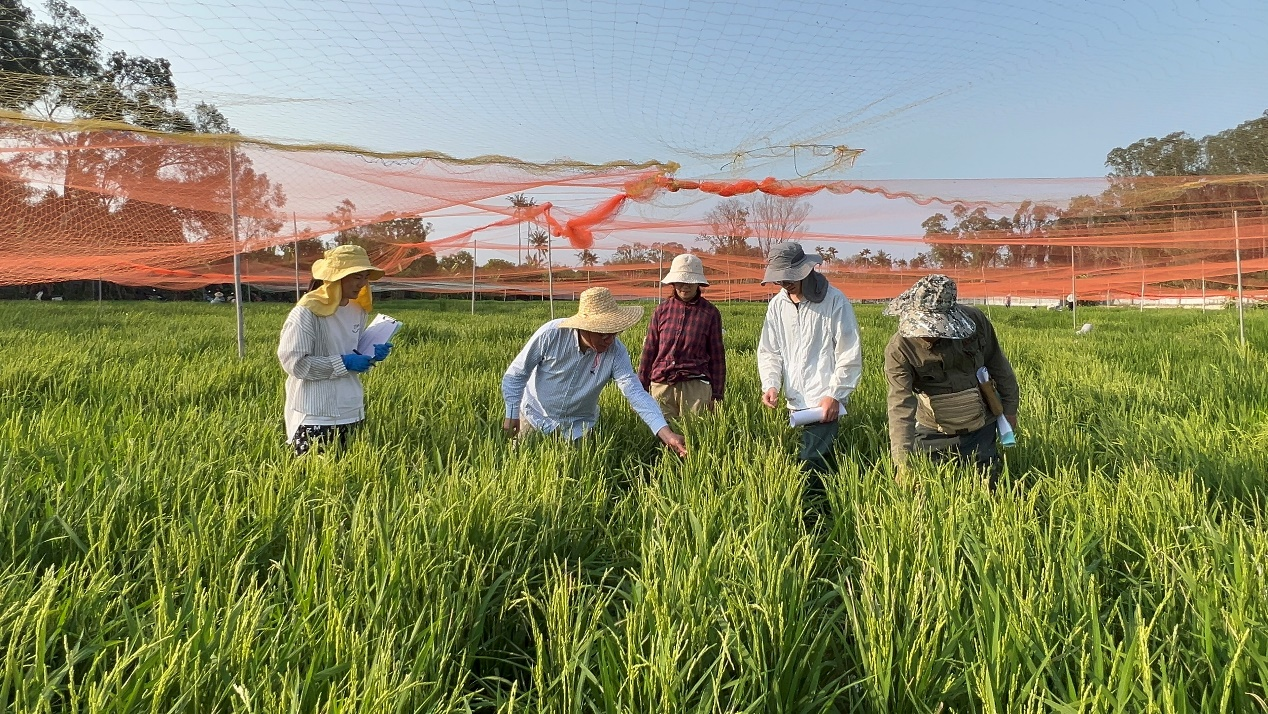
Professor Zuhua He (second from left), together with Hui Lin (first from left) and other team members, observes rice phenotypes in the field to obtain key data for breeding disease-resistant varieties.
Article Link: https://www.nature.com/articles/s41586-026-10361-6
Contact: hlin@cemps.ac.cn

Copyright @copy 2002-
CAS Center for Excellence in Molecular Plant Sciences / Institute of Plant Physiology and Ecology
All rights reserved
Address: 300 Feng Lin Road, Shanghai 200032, China
Tel: 86-21-54924000
Fax: 86-21-54924015
Email: webmaster@sippe.ac.cn